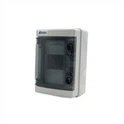
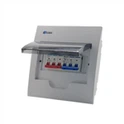
The circuit breaker is generally composed of a contact system, an arc extinguishing system, an operating mechanism, a trip unit, and a shell. When a short circuit occurs, the magnetic field generated by the large current (generally 10 to 12 times) overcomes the reaction force spring, the trip unit pulls the operating mechanism to move, and the switch instantaneously trips. When overloaded, the current becomes larger, the heat generation increases, and the bimetal deforms to a certain extent to push the mechanism to move (the larger the current, the shorter the action time).
There is an electronic type that uses a transformer to collect the current of each phase and compares it with the set value. When the current is abnormal, the microprocessor sends a signal to make the electronic release drive the operating mechanism. The function of the circuit breaker is to cut off and connect the load circuit, as well as cut off the faulty circuit, to prevent the expansion of the accident and ensure safe operation. The high-voltage circuit breaker needs to break the 1500V, current 1500-2000A arc, these arcs can be stretched to 2m and still continue to burn and not extinguish. Therefore, arc extinguishing is a problem that high-voltage circuit breakers must solve.