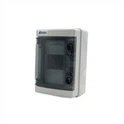
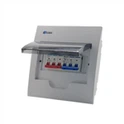
1. Turn off the power supply to the electrical panel.
Locate the Service Disconnect or Main circuit breaker in the panel and set it to the "Off" position. This circuit breaker is likely to have the largest amp value and will be located either at the top or bottom of the panel.
If you don’t see a circuit breaker labeled "Service Disconnect" or "Main" in the panel, it is likely in another panel in the building or in the meter socket enclosure (a separate, usually gray box that houses the utilities meter for many houses and mobile homes and that is connected to various circuit breakers throughout one section of a building). Look for other panel(s) as needed until you find this main circuit breaker.Turn off all computers in your home before switching off the power, as they may be damaged by suddenly losing power.
2. Inspect the circuit breaker arrangement for unused locations.
Look for a blank area on the electrical panel that could accommodate a circuit breaker, paying particular attention to unused spaces at the top and bottom of the cover. Some manufacturers of electrical panels have removable knockouts or plates at these locations, but the panel itself lacks provisions to mount a circuit breaker.
If the unused location has a knockout plate over it, you’ll have to eventually remove it before completing the installation process. For now, you simply need to identify a space where you can install the circuit breaker.
3. Remove the electrical panel cover.
Use a screwdriver to remove 3 of the screws supporting the cover. Then, use 1 arm to hold the panel cover in place as you unscrew the last screw. Finally, pull the cover away from the panel.[3]Be sure to hold the panel cover tightly in place as you remove the screws; if the cover slips and falls, it could damage the breaker handles.If you’re unable to hold the panel cover in place with 1 hand, ask a friend to help you.
4. Test the panel to make sure the power is off.
Use a test light or meter set to check for the presence of power. Touch 1 probe to ground (the bar that has bare or green and white wires connected) or neutral (the bar that has just white or just bare or green wires connected) and touch the other probe to the screw terminal of a circuit breaker that has a black, red, or blue insulated wire connected. If 120 (or more) volts is indicated, the panel is still being powered and will need to be turned off before proceeding.
Make sure your test light is set to the highest AC voltage range available (and is set at minimum to 120 volts).If the Service Disconnect or Main circuit breaker is in this panel, it will always indicate power on the terminals that have cables connected. The output of the Main or Service Disconnect when located in the panel, connects to the bus bar. The bus bar should have no power present when this breaker is OFF. Testing at the Service Disconnect or Main circuit breaker is not recommended due to this "seemingly conflicting" information.It is not safe to install a circuit breaker in an electrical panel that still has power flowing to it. Do not continue if power is present on a circuit breaker other than Service Disconnect or Main circuit breaker, until the power source has been shut off.